
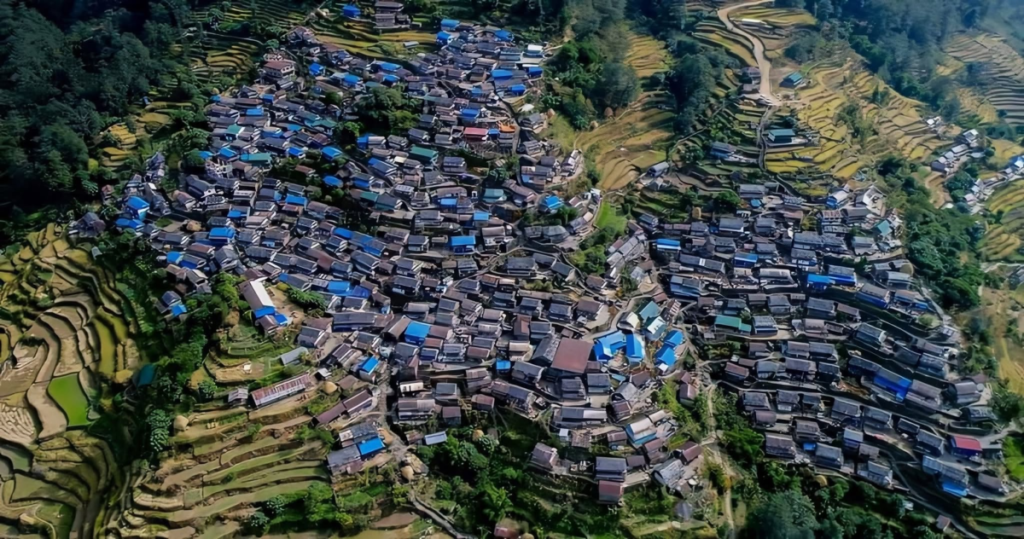
Hidden among the green hills of Lamjung District in Gandaki Province, Bhujung Village is one of Nepal’s largest and most culturally significant Gurung settlements. Located in Ward No. 4 of Kwholasothar Rural Municipality at an elevation of approximately 1,620 metres (5,315 feet), the village offers visitors an authentic Himalayan experience where culture, nature, and community life remain deeply connected.
Unlike many commercialized tourist destinations, Bhujung has preserved its traditional lifestyle — stone-built houses, terraced farmland, community forests, and centuries-old Gurung customs still shape everyday life here. Visitors are welcomed not only by spectacular mountain scenery but by genuine hospitality, organic home-cooked food, cultural performances, and the unhurried pace of village life.
Whether you’re drawn by cultural immersion, a trekking route through the Annapurna and Manaslu foothills, a homestay experience with a Gurung family, or the extraordinary tradition of Himalayan wild honey hunting, Bhujung is one of Nepal’s most rewarding lesser-known destinations.
Quick Facts
| Information | Details |
|---|---|
| Country | Nepal |
| Province | Gandaki Province |
| District | Lamjung |
| Municipality | Kwholasothar Rural Municipality – Ward No. 4 |
| Elevation | 1,620 m (5,315 ft) |
| Community | Predominantly Gurung |
| Households | 362 |
| Registered Homestays | 33 |
| Main Occupations | Agriculture, livestock rearing, homestay tourism, wild honey hunting |
| Famous For | Gurung culture, Himalayan wild honey hunting, organic farming, community-based tourism |
| Best Time to Visit | March–May and September–November |
| Nearest Town | Besisahar (district headquarters of Lamjung) |
(Note: household counts, homestay numbers, and similar figures are as supplied for this article and worth a quick reconfirmation with the ward office before publishing, since these can shift year to year.)
Where Is Bhujung Village?
Bhujung Village is located in Ward No. 4 of Kwholasothar Rural Municipality, Lamjung District, Gandaki Province, Nepal. It sits roughly 190 kilometres from Kathmandu and about 95 kilometres from Pokhara, making it reachable from both of Nepal’s major tourist hubs within a day’s travel.
History of Bhujung Village
Bhujung has been home to the Gurung community for generations and is regarded as one of the most important traditional Gurung villages in Nepal. Despite the gradual arrival of modern development — roads, electricity, mobile signal — the village has held onto its cultural identity, architecture, language, and community values.
Stone-paved pathways connect clusters of traditional houses surrounded by terraced fields and forest, a layout shaped by generations of cooperative farming and communal life. Local committees and community forestry groups still play a central role in daily decision-making, which has helped keep customs intact even as tourism slowly reaches the village.
Today, Bhujung stands as a working example of community-based tourism — a place where visitors can experience genuine village life while directly supporting local livelihoods and cultural preservation, rather than a destination built around tourism from the outset.
Gurung Culture and Heritage
Culture is at the heart of Bhujung Village. The Gurung community has carefully preserved its traditions through music, dance, festivals, language, and hospitality, and much of it is still visible in everyday village life rather than staged for visitors.
Travelers can experience:
- Traditional Gurung houses built with local stone and timber
- Traditional Gurung dress and ornaments, especially during festivals
- Ghatu Dance — a ritual dance performed by young girls
- Serka Dance and Krishna Charitra Dance — traditional performance forms
- Live traditional music using local instruments
- Community celebrations, rituals, and seasonal rites
- Local handicrafts and indigenous ecological knowledge passed down through generations
The warm hospitality of the Gurung people is often what visitors remember most — guests are welcomed into homes and daily routines rather than kept at arm’s length, which makes a stay in Bhujung feel like genuine cultural exchange rather than sightseeing.
Why Visit Bhujung Village?
Bhujung is more than a scenic Himalayan village — it’s a living cultural landscape where old traditions continue to function as part of daily life. Visitors choose Bhujung for:
- Authentic Gurung culture and hospitality
- Community-based homestay experiences
- Himalayan wild honey hunting, a tradition found in very few places on earth
- Organic farming and genuinely fresh, local food
- Traditional stone architecture and village layout
- Scenic hiking and trekking routes with Annapurna and Manaslu views
- Forests, waterfalls, and terraced landscapes
- Cultural dances and local festivals
- Sustainable, community-led rural tourism rather than mass tourism
Each season shows a different side of the village — spring brings rhododendron blooms and clear mountain views, while autumn brings harvest activity and some of the year’s biggest festivals.
Occupation and Livelihood
Agriculture is the primary occupation of the people of Bhujung. Most households practice subsistence farming and livestock rearing, producing enough food for their families while selling surplus produce in nearby markets. Organic farming remains a way of life here, with residents cultivating rice, millet (kodo), maize, potatoes, beans, and seasonal vegetables and fruits using traditional methods passed down through generations. Many families also raise buffaloes, cows, goats, sheep, and poultry, which provide milk, meat, and additional household income.
In recent years, community homestays, eco-tourism, and Himalayan wild honey hunting have become important additional sources of income — giving families a way to earn from tourism without abandoning their agricultural way of life. This blend of old and new livelihoods is part of what makes a visit to Bhujung feel authentic rather than curated for outsiders.
Organic Farming in Bhujung
Nearly every household in Bhujung maintains a kitchen garden supplying fresh vegetables and herbs through the year, alongside larger terraced fields of rice, millet, and maize. Farming here relies on traditional, largely chemical-free methods — partly out of custom, partly out of necessity given the village’s remote location — which means the produce that ends up on a homestay dinner table is about as close to “farm to table” as travel experiences get.
This organic farming tradition directly shapes the food served to visitors, and increasingly, it’s becoming part of the reason people visit — several homestays now offer short farm walks or garden tours as part of the stay.
Himalayan Wild Honey Hunting
Bhujung is one of Nepal’s renowned destinations for traditional Himalayan wild honey hunting. Skilled Gurung honey hunters climb towering cliffs using handmade bamboo ladders and natural fiber ropes to harvest honey from the Giant Himalayan Honey Bee (Apis laboriosa) — the world’s largest honey bee species.
This tradition has been practiced for centuries and represents remarkable courage, teamwork, and generations of indigenous ecological knowledge about bee behavior, cliff faces, and seasonal timing. The hunt is typically carried out twice a year, in spring and autumn, and involves the whole community in preparation and support roles, not just the climbers themselves.
Today, wild honey hunting has become an important cultural tourism draw, attracting photographers, documentary filmmakers, researchers, and adventure travelers from around the world who want to witness — and in some cases help document — one of the most striking human-nature traditions left in the Himalayas.
Flora and Fauna
Bhujung sits within a mixed hill-forest ecosystem typical of Nepal’s mid-hills, with community-managed forests surrounding the village that support:
- Rhododendron forests (in bloom during spring)
- Oak and pine forest cover at higher elevations
- Medicinal and wild plants used in traditional local remedies
- Birdlife typical of the mid-hill Himalayan region
- Occasional wildlife sightings including langurs and smaller forest mammals
The community forestry system that manages this land is also part of why the area has stayed relatively untouched — local user groups actively regulate logging and land use, which has helped preserve the forest cover surrounding the village.
Traditional Foods of Bhujung
Visitors staying in Bhujung homestays can enjoy authentic Gurung cuisine prepared with fresh, organic ingredients grown just outside the kitchen door. Popular dishes include:
- Dhindo — a traditional millet or maize porridge, a staple of hill cuisine
- Kodo ko Roti — flatbread made from millet flour
- Local chicken curry and fresh river fish, when in season
- Mutton curry, often reserved for festivals and special occasions
- Niguro (fiddlehead fern) and Sisnu (nettle soup) — foraged seasonal greens
- Seasonal organic vegetables straight from the family garden
- Homemade pickles (achar)
- Locally produced honey, including the wild Himalayan honey the village is known for
Every meal reflects the culinary traditions of the Gurung community — simple, seasonal, and built around what the land actually provides rather than a menu designed for tourists.
Festivals in Bhujung
The Gurung festival calendar shapes much of village life throughout the year. The most significant celebrations include:
- Tamu Lhosar — the Gurung New Year, typically celebrated in Poush/late December to January, with traditional dress, feasting, and dance
- Tihar — the festival of lights, celebrated with the whole village lit by oil lamps
- Seasonal harvest festivals tied to the farming calendar
- Community puja (worship) days observed at local shrines and monasteries
Visiting during a festival period offers a far deeper look at Gurung culture than a typical visit — but even outside festival season, community life in Bhujung stays visibly active.
Homestay Experience
With 33 registered homestays, Bhujung offers one of the more established community homestay networks in the Lamjung region. Staying with a Gurung family means:
- A private or shared room in a traditional stone-and-timber home
- Home-cooked meals using the family’s own farm produce
- Direct conversation and cultural exchange with your hosts
- Opportunities to join daily activities — farming, cooking, weaving — if you’re interested
- Support that goes directly to the household hosting you, rather than an outside operator
Homestays are coordinated through the village’s tourism committee, which helps distribute guests fairly across registered households and maintains basic hospitality standards.
Trekking and Hiking Trails
Bhujung serves as a trailhead and rest stop for several routes through the Annapurna and Manaslu foothills, including:
- Short 1–2 day village and viewpoint walks for visitors with limited time
- Multi-day treks connecting toward Mardi Himal, Dudhpokhari, and further into the Annapurna Conservation Area
- Longer routes toward Manaslu Circuit trailheads for more experienced trekkers
The trails around Bhujung pass through forest, terraced farmland, and smaller Gurung settlements, offering mountain views without the crowds found on Nepal’s most famous routes.
Things to Do in Bhujung
- Take a guided village walk through Bhujung’s stone lanes and traditional houses
- Hike to a nearby viewpoint for sunrise or sunset over the valley
- Visit a working farm or kitchen garden with your homestay host
- Learn about (or, in season, witness) Himalayan wild honey hunting
- Join a Gurung cultural performance if one coincides with your visit
- Try traditional Gurung cooking with your host family
- Shop for handwoven Dhaka textiles and local handicrafts
- Walk to nearby waterfalls or river spots for a half-day outing
Nearby Attractions
- Ghalegaun — a well-known neighboring Gurung village and a common stop on the same route
- Besisahar — the district headquarters of Lamjung and gateway town
- Annapurna Conservation Area trailheads accessible from the wider Bhujung–Ghalegaun corridor
- Smaller Gurung villages along the Sundarbazar–Gilung–Maling route from Pokhara
Best Time to Visit Bhujung
- Spring (March–May): Rhododendron blooms, clear skies, and one of the two honey-hunting seasons
- Autumn (September–November): The most popular season — stable weather, excellent mountain visibility, and major festivals like Tihar
- Monsoon (June–August) brings lush green landscapes but muddy trails and limited visibility
- Winter (December–February) is quiet and cold at this elevation, though Tamu Lhosar celebrations fall in this window
How to Reach Bhujung Village
From Kathmandu: Kathmandu → Dumre → Besisahar → Khudi → Ghalegaun → Bhujung
From Pokhara: Pokhara → Begnas → Sundarbazar → Gilung → Maling → Ghalegaun → Bhujung
Both routes combine paved highway driving with rural mountain roads for the final stretch, and are typically covered by private vehicle, local bus, or jeep. Many travelers break the journey with an overnight stop in Ghalegaun before continuing to Bhujung.
Responsible Tourism in Bhujung
Bhujung’s tourism model is built around community benefit rather than large-scale commercial development, and visitors can help keep it that way:
- Book homestays through the village’s tourism committee rather than bypassing local coordination
- Ask before photographing people, ceremonies, or private homes
- Support local guides, porters, and homestay hosts directly
- Avoid single-use plastic where possible — bring a reusable water bottle
- Respect farmland, community forest boundaries, and local customs during festivals
Travel Tips
- Mobile network and electricity are available but can be inconsistent — plan accordingly
- Carry cash; card payment options are limited in the village
- Basic English is spoken by some hosts and guides, but a few Nepali phrases go a long way
- Layered clothing is recommended year-round given the elevation and hill-country weather swings
- Confirm homestay availability in advance during major festival periods, when local demand is higher
Frequently Asked Questions
Where is Bhujung Village located? Bhujung Village is in Ward No. 4 of Kwholasothar Rural Municipality, Lamjung District, Gandaki Province, Nepal, at an elevation of approximately 1,620 metres.
How do I get to Bhujung Village from Kathmandu? The typical route is Kathmandu → Dumre → Besisahar → Khudi → Ghalegaun → Bhujung, usually by private vehicle or local bus/jeep.
How do I get to Bhujung Village from Pokhara? From Pokhara, the route runs Pokhara → Begnas → Sundarbazar → Gilung → Maling → Ghalegaun → Bhujung.
What is Bhujung famous for? Bhujung is known for its Gurung culture, community-based homestays, organic farming, and its tradition of Himalayan wild honey hunting.
Are there homestays in Bhujung? Yes — Bhujung has a network of registered homestays coordinated through the village’s tourism committee, offering stays with local Gurung families.
What is Himalayan wild honey hunting? It’s a traditional practice where Gurung honey hunters climb cliffs using bamboo ladders and rope to harvest honey from the Giant Himalayan Honey Bee, one of the world’s largest bee species. It’s typically carried out twice a year, in spring and autumn.
What is the best time to visit Bhujung? March to May and September to November offer the clearest weather and best mountain visibility, and align with two of the region’s most active cultural seasons.
Is Bhujung good for trekking? Yes — Bhujung is a trailhead for routes toward Mardi Himal, Dudhpokhari, and the wider Annapurna and Manaslu foothills, suited to both short hikes and multi-day treks.
What food can I expect to eat in Bhujung? Homestay meals typically include dhindo, kodo ko roti, local chicken or river fish, seasonal vegetables, foraged greens like niguro and sisnu, homemade pickles, and locally produced honey.
Is Bhujung suitable for a short visit, or does it need several days? Both work — a night or two gives a genuine taste of homestay life and a village walk, while 3+ days allows time for a nearby trek, a farm visit, and a deeper cultural experience.
Conclusion
Bhujung Village offers something increasingly rare in Nepal’s tourism landscape: a destination where culture, agriculture, and hospitality haven’t been rebuilt around tourism, but simply opened up to it. Between its Gurung heritage, working organic farms, honey-hunting tradition, and community-run homestay network, a visit to Bhujung supports the village directly while giving travelers a far more genuine picture of Himalayan hill life than most itineraries allow.
Whether you come for a single overnight homestay or build a multi-day trek around it, Bhujung rewards visitors who are looking for substance over spectacle.